Plan the Space Before Delivery
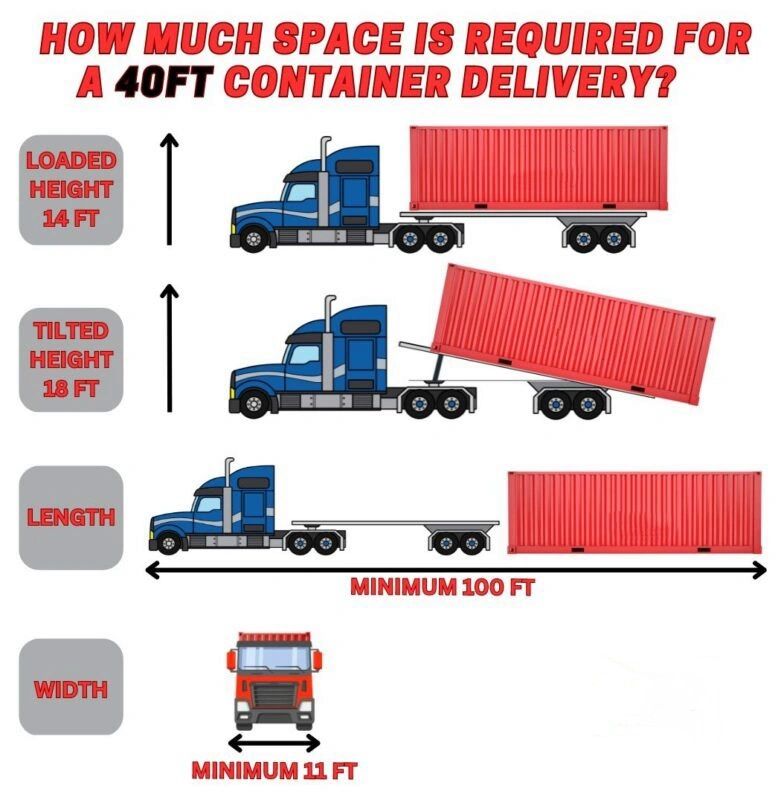
Container size, trailer type and door orientation all affect the clear space needed for a safe delivery. Review these diagrams and tell our team about gates, curves, overhead obstacles, grades or other access limitations before dispatch.
Doors to Cab vs Doors to Rear
Doors to Cab
In the “Doors to Cab” configuration, the container doors are positioned near the truck cab. Because the container slides off the trailer from the rear, this orientation generally places the doors opposite the direction the truck departs.
Doors to Rear
In the “Doors to Rear” configuration, the doors are positioned at the rear of the trailer and touch the ground first during unloading. Confirm the direction you want the doors to face before dispatch so the container can be loaded correctly.
Guidelines for a Successful Delivery
Delivery trucks are designed for dry, compacted surfaces such as asphalt or concrete. The trucks are not guaranteed to be four-wheel drive, so they can lose traction and become stuck when moved off sealed roads. Compacted dirt and gravel can be suitable when dry.
Unsuitable ground includes loose dirt, wet or muddy areas, sand, soft grass, ice and snow, steep inclines or declines, sloping surfaces, drains, ditches and trenches. The delivery path and drop site must also be free of rocks, stumps, debris and tree limbs that could damage equipment. At minimum, the drop site should be accessible from a maintained two-lane county road.
The Drop Site
The site where the container will sit should be level, and the ground where the truck parks while unloading must also be level. The chosen site should not require the tractor or trailer to travel up or down unpaved, sloping terrain to complete delivery.
The container's weight needs to be distributed across its four corner castings. Concrete and asphalt are excellent choices. Stone pavers, hard wood blocks, railroad ties or compacted gravel may also be placed at the corners to keep the unit level and distribute its weight evenly.
Why level matters: If the container is not level, the doors can bind or pinch and become difficult to operate.
Planning Your Delivery
Your drop site should be ready before the container arrives. We allot 30 minutes for the driver and equipment to unload the container and complete delivery. Excess time on site may result in an additional charge.
On delivery day, you must be reachable by phone. Keep the path to the drop site clear of vehicles and other obstacles, and consider notifying neighbors of the planned delivery. The driver will inspect the drop site before unloading. If the site is unsafe or inaccessible, the driver will not proceed. We recommend identifying an alternate location in advance.
If you ask the driver to attempt delivery at a site judged unsuitable, you may be asked to sign a waiver accepting responsibility for possible container damage, additional unloading time and vehicle-recovery costs if the truck becomes stuck.
Inclement Weather
You are our eyes and ears at the delivery location. If rain, snow, high heat or other conditions make access unsafe, contact us so delivery can be rescheduled. For delivery roads, paths or sites that are not concrete or asphalt, please call 304-617-2946 when bad weather is forecast or when the ground remains wet from recent precipitation.
Delivery-Date Estimates and Rescheduling
Delivery dates are estimates and are not guaranteed. A delivery may need to be rescheduled because of another job-site recovery, driver illness, equipment failure, weather or another issue outside your control. We will work to reschedule and deliver your container as soon as possible.
Issues and Cancellations
If the driver cannot place the container at your preferred location, it may be placed at the next closest suitable location. Cash refunds are not provided, and refusing delivery may result in additional fees. Most problems can be avoided by reviewing these guidelines carefully and confirming that the intended drop site is suitable.
Following these guidelines and preparing the delivery site in advance will help provide a safe and successful delivery.